| Brand Name: | Chemfine |
| Model Number: | B5 |
| Packaging Details: | 230kg plastic drum; 1000L IBC tank; 20CBM flexitank for bulk shipment; customized packaging available upon request |
| Item | Standard Specification |
|---|---|
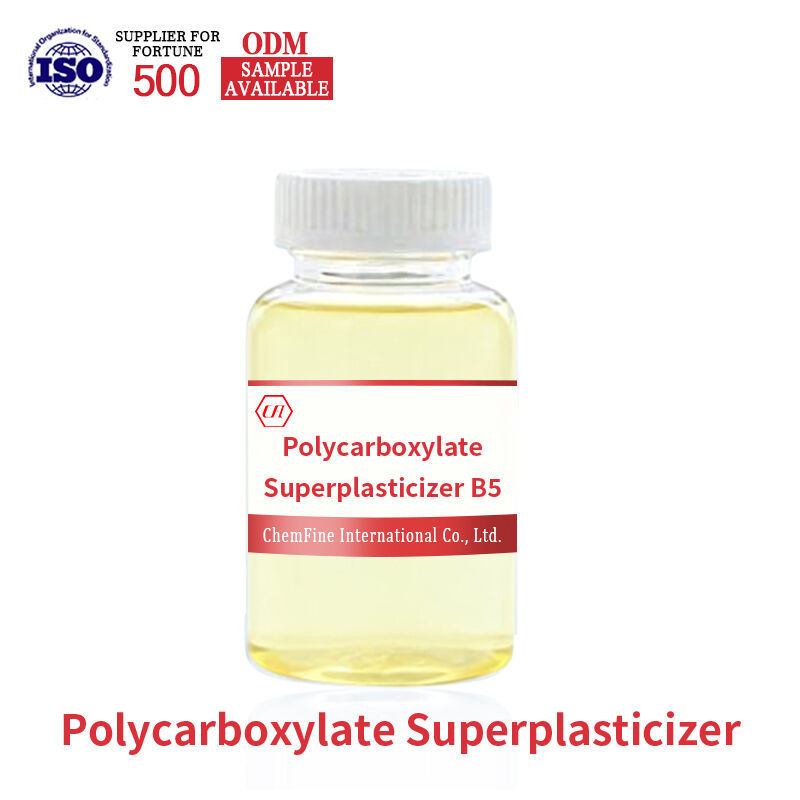
| Appearance | Colorless to light yellow homogeneous liquid |
| Solid Content | 49 - 51 % |
| Density (25℃) | 1.08 - 1.12 g/cm³ |
| pH Value (20℃) | 4 - 6 |
| Chloride Content | ≤ 0.1 % |
| Total Alkali Content | ≤ 1.0 % |
| Slump Retention Rate (1h) | ≥ 90 % (GB 8076-2008 standard) |
| CONCLUSION | Conforms to GB 8076-2008 Standard |
B5 type polycarboxylate superplasticizer is a high-performance slump retention type concrete admixture developed with independent advanced synthesis technology, with modified polycarboxylate copolymer as the main active component.
This product features super slump retention effect and strong late slow-release water reducing function, which can effectively maintain concrete fluidity for a long time, and is especially suitable for long-distance transportation and high-temperature construction scenarios. It can be used alone or compounded with high water-reducing PCE to flexibly meet different construction requirements. With low alkali content and no chloride ion corrosion to steel reinforcement, it also helps improve the compressive strength and durability of concrete. It fully complies with GB 8076-2008 Concrete Admixtures standard, and is widely used in various ready-mixed concrete, high strength concrete, self-compacting concrete and other projects requiring long-time workability retention.
Long-distance Transportation Ready-mixed Concrete (Core Application): The most targeted application scenario. B5 is specially designed for commercial concrete that requires long-distance transportation from batching plant to construction site. It maintains stable slump and workability during transportation, avoids performance degradation caused by long journey, ensures concrete quality at the construction site, and supports cross-regional concrete supply.
High Temperature Season Construction: Performs excellently in high temperature climate in summer. It solves the common industry pain point of rapid concrete slump loss under high temperature, extends the operable time of fresh concrete, ensures smooth pumping and pouring construction, and reduces construction waste caused by premature slump loss.
High & Ultra-high Strength Concrete: Suitable for C60 and above high strength, ultra-high strength concrete projects. While maintaining excellent construction workability for a long time, it ensures low water-cement ratio, improves concrete compactness, compressive strength and long-term durability, and meets the requirements of key projects such as high-rise buildings and large-span bridges.
Self-compacting Concrete: Enables concrete to maintain excellent self-leveling and self-compacting performance for a long time, adapts to the construction rhythm of complex structural components, avoids performance attenuation during pouring construction, ensures dense forming of components with dense reinforcement and complex shape.
Large-volume & Long-period Construction Projects: Suitable for large-volume concrete, continuous pouring projects and construction sites with uncertain schedule. It provides sufficient operation time window, reduces the risk of cold joints caused by concrete setting time mismatch, and improves the overall construction quality of large-scale projects.
Pumping Concrete with Complex Working Conditions: For pumping construction with long pipeline and high pumping height, B5 maintains stable fluidity and pumpability of concrete during the whole pumping process, reduces pumping resistance, lowers the risk of pipe blockage, and ensures smooth completion of pumping construction under complex working conditions.
A1: The core difference lies in functional focus and action mode. H1 focuses on ultra-high initial water reduction efficiency, which can greatly reduce water-cement ratio and improve concrete strength. B5 focuses on long-term slump retention with slow-release mechanism, which can effectively inhibit slump loss over time. In practical application, the two are often compounded in proportion to achieve the effect of both high initial water reduction and long-term slump retention.
A2: The recommended dosage is 0.3-1.5% of the total weight of cementitious materials. When used alone for slump retention, the dosage can be adjusted according to slump retention demand; when compounded with high water-reducing PCE, the proportion of B5 can be flexibly adjusted according to transportation time and ambient temperature. The optimum dosage must be confirmed through concrete trial mixing tests combined with local raw materials.
A3: B5 can be blended with other high water-reducing type polycarboxylate (PCE) superplasticizers in any proportion to adjust the balance of initial water reduction and slump retention. However, it cannot be used together with naphthalene-based superplasticizers. Incompatibility between different types of admixtures will lead to sharp slump loss and workability deterioration. When switching admixture types, the mixing equipment and dosing system must be thoroughly cleaned.
A4: B5 should be stored in tightly sealed original containers at an ambient temperature of 0-40℃. Measures must be taken to prevent freezing and long-term direct sunlight exposure. Under proper storage conditions, the minimum shelf life is 12 months. If the product exceeds the shelf life, it must be tested and confirmed qualified before use.
A5: No. B5 polycarboxylate superplasticizer has a chloride ion content of ≤0.1% and contains no corrosive components to steel reinforcement. It will not induce steel bar corrosion in concrete, and can effectively ensure the long-term durability and structural safety of reinforced concrete buildings, suitable for various reinforced concrete structures.
A6: B5 has good adaptability to most common cementitious materials, including ordinary Portland cement, composite cement, fly ash, ground granulated blast furnace slag powder and other mineral admixtures. For special cement types or special mineral admixtures, it is recommended to conduct a compatibility test first to confirm the optimum dosage and slump retention effect.
| Brand Name: | Chemfine |
| Model Number: | B5 |
| Packaging Details: | 230kg plastic drum; 1000L IBC tank; 20CBM flexitank for bulk shipment; customized packaging available upon request |
| Item | Standard Specification |
|---|---|
| Appearance | Colorless to light yellow homogeneous liquid |
| Solid Content | 49 - 51 % |
| Density (25℃) | 1.08 - 1.12 g/cm³ |
| pH Value (20℃) | 4 - 6 |
| Chloride Content | ≤ 0.1 % |
| Total Alkali Content | ≤ 1.0 % |
| Slump Retention Rate (1h) | ≥ 90 % (GB 8076-2008 standard) |
| CONCLUSION | Conforms to GB 8076-2008 Standard |
B5 type polycarboxylate superplasticizer is a high-performance slump retention type concrete admixture developed with independent advanced synthesis technology, with modified polycarboxylate copolymer as the main active component.
This product features super slump retention effect and strong late slow-release water reducing function, which can effectively maintain concrete fluidity for a long time, and is especially suitable for long-distance transportation and high-temperature construction scenarios. It can be used alone or compounded with high water-reducing PCE to flexibly meet different construction requirements. With low alkali content and no chloride ion corrosion to steel reinforcement, it also helps improve the compressive strength and durability of concrete. It fully complies with GB 8076-2008 Concrete Admixtures standard, and is widely used in various ready-mixed concrete, high strength concrete, self-compacting concrete and other projects requiring long-time workability retention.
Long-distance Transportation Ready-mixed Concrete (Core Application): The most targeted application scenario. B5 is specially designed for commercial concrete that requires long-distance transportation from batching plant to construction site. It maintains stable slump and workability during transportation, avoids performance degradation caused by long journey, ensures concrete quality at the construction site, and supports cross-regional concrete supply.
High Temperature Season Construction: Performs excellently in high temperature climate in summer. It solves the common industry pain point of rapid concrete slump loss under high temperature, extends the operable time of fresh concrete, ensures smooth pumping and pouring construction, and reduces construction waste caused by premature slump loss.
High & Ultra-high Strength Concrete: Suitable for C60 and above high strength, ultra-high strength concrete projects. While maintaining excellent construction workability for a long time, it ensures low water-cement ratio, improves concrete compactness, compressive strength and long-term durability, and meets the requirements of key projects such as high-rise buildings and large-span bridges.
Self-compacting Concrete: Enables concrete to maintain excellent self-leveling and self-compacting performance for a long time, adapts to the construction rhythm of complex structural components, avoids performance attenuation during pouring construction, ensures dense forming of components with dense reinforcement and complex shape.
Large-volume & Long-period Construction Projects: Suitable for large-volume concrete, continuous pouring projects and construction sites with uncertain schedule. It provides sufficient operation time window, reduces the risk of cold joints caused by concrete setting time mismatch, and improves the overall construction quality of large-scale projects.
Pumping Concrete with Complex Working Conditions: For pumping construction with long pipeline and high pumping height, B5 maintains stable fluidity and pumpability of concrete during the whole pumping process, reduces pumping resistance, lowers the risk of pipe blockage, and ensures smooth completion of pumping construction under complex working conditions.
A1: The core difference lies in functional focus and action mode. H1 focuses on ultra-high initial water reduction efficiency, which can greatly reduce water-cement ratio and improve concrete strength. B5 focuses on long-term slump retention with slow-release mechanism, which can effectively inhibit slump loss over time. In practical application, the two are often compounded in proportion to achieve the effect of both high initial water reduction and long-term slump retention.
A2: The recommended dosage is 0.3-1.5% of the total weight of cementitious materials. When used alone for slump retention, the dosage can be adjusted according to slump retention demand; when compounded with high water-reducing PCE, the proportion of B5 can be flexibly adjusted according to transportation time and ambient temperature. The optimum dosage must be confirmed through concrete trial mixing tests combined with local raw materials.
A3: B5 can be blended with other high water-reducing type polycarboxylate (PCE) superplasticizers in any proportion to adjust the balance of initial water reduction and slump retention. However, it cannot be used together with naphthalene-based superplasticizers. Incompatibility between different types of admixtures will lead to sharp slump loss and workability deterioration. When switching admixture types, the mixing equipment and dosing system must be thoroughly cleaned.
A4: B5 should be stored in tightly sealed original containers at an ambient temperature of 0-40℃. Measures must be taken to prevent freezing and long-term direct sunlight exposure. Under proper storage conditions, the minimum shelf life is 12 months. If the product exceeds the shelf life, it must be tested and confirmed qualified before use.
A5: No. B5 polycarboxylate superplasticizer has a chloride ion content of ≤0.1% and contains no corrosive components to steel reinforcement. It will not induce steel bar corrosion in concrete, and can effectively ensure the long-term durability and structural safety of reinforced concrete buildings, suitable for various reinforced concrete structures.
A6: B5 has good adaptability to most common cementitious materials, including ordinary Portland cement, composite cement, fly ash, ground granulated blast furnace slag powder and other mineral admixtures. For special cement types or special mineral admixtures, it is recommended to conduct a compatibility test first to confirm the optimum dosage and slump retention effect.