| Brand Name: | Chemfine |
| Packaging Details: | 25kg / 50kg plastic drum; 1000L IBC tote; Customized packaging available upon request |
| Grade | Specific Gravity (S.G.) | Solid Content | pH | Average Particle Size (μm) | Character | Main Applications |
|---|---|---|---|---|---|---|
| SD-10 | 2.175-2.199 | 60±2% | 9.0-10.0 | 0.2-0.4 | Milk white liquid | Impregnation of packings |
| SD-20 | 2.20-2.22 | 60±2% | 9.0-10.0 | 0.15-0.35 | Milk white liquid | Impregnation of glass fiber and non-woven fabric (high temperature resistant) |
| SD-20K | 2.175-2.199 | 60±2% | 9.0-10.0 | 0.15-0.35 | Milk white liquid | Anti-dripping agent |
| SD-30 | 2.16-2.18 | 60±2% | 9.0-10.0 | 0.15-0.3 | Milk white liquid | Metallic coating (non-stick coating) |
| SD-33 | 2.16-2.18 | 60±2% | 9.0-10.0 | 0.15-0.3 | Milk white liquid | Metallic coating (non-stick coating, gloss improvement) |
| SD-40 | 2.16-2.18 | 60±2% | 9.0-10.0 | 0.15-0.3 | Milk white liquid | Metallic coating (non-stick coating, crack resistance improvement) |
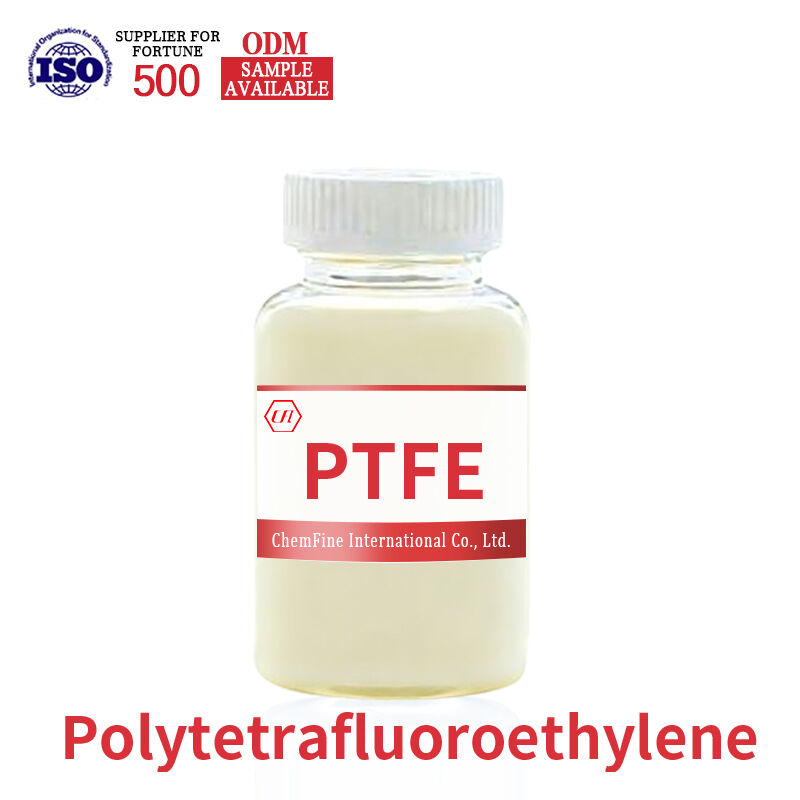
PTFE dispersion liquid (polytetrafluoroethylene aqueous emulsion, CAS 9002-84-0) is a high-performance water-based fluoropolymer emulsion prepared by emulsion polymerization of tetrafluoroethylene monomer.
It fully retains all excellent properties of PTFE resin, such as outstanding high and low temperature resistance, excellent chemical corrosion resistance, remarkable non-stick property and superior weather resistance. With 60±2% stable solid content and a complete SD grade matrix with different particle sizes and performances, it can be applied by dipping, spraying, roller coating and other processes. After high temperature sintering, it forms a dense and durable PTFE functional coating. It is widely used in non-stick cookware coating, industrial metal anti-corrosion coating, glass fiber and sealing packing impregnation, plastic flame retardant anti-dripping modification, fabric and filter bag coating and other fields. It is a versatile basic fluorine-containing functional material with wide industrial applications.
Non-stick Cookware & Bakeware Coating (Core Application): The most widely used scenario. SD-30, SD-33 and SD-40 grades are used as base coating or functional top coating for non-stick pans, baking trays, cake molds and other cookware. The cured PTFE coating has excellent non-stick property, high temperature resistance and food contact safety, is easy to clean, and maintains stable performance under long-term high-temperature cooking. Different grades can provide enhanced gloss or improved crack resistance to meet different product positioning.
Sealing Packing & Fiber Material Impregnation: SD-10 and SD-20 grades are used for impregnation of PTFE packing, aramid packing, glass fiber cloth and high temperature non-woven fabric. After impregnation and sintering, it significantly improves the high temperature resistance, corrosion resistance, wear resistance and sealing performance of fiber and packing products, extends service life, and is suitable for manufacturing high-performance sealing materials and high temperature resistant fiber products.
Industrial Metal Anti-corrosion Coating: Applied on the surface of metal fasteners, chemical equipment parts, pipelines and valves as heavy anti-corrosion protective layer. It resists erosion of strong acid, strong alkali, organic solvent and corrosive gas for a long time, provides long-term reliable protection for metal workpieces in harsh corrosive environments, and is widely used in chemical industry, electric power and marine engineering fields.
Plastic Flame Retardant Anti-dripping Additive: SD-20K grade is used as anti-dripping agent in flame retardant modification of engineering plastics such as PC, ABS and PA. After blending, it can effectively inhibit the dripping of molten droplets during plastic combustion, prevent secondary combustion, improve the flame retardant grade of materials, and is an important additive for halogen-free flame retardant systems.
Fabric & Filter Bag Functional Coating: Coated on industrial high-temperature filter bags, special functional fabrics and architectural membrane materials. It endows fabrics with excellent water and oil repellency, chemical corrosion resistance and dust release property, improves filtration efficiency and service life of filter materials, and is suitable for high-temperature dust removal, chemical filtration and other fields.
Other Special Functional Applications: Also used for surface coating of polyimide film, electronic components and special materials, providing functions such as high temperature resistance, insulation, anti-sticking and anti-fouling, and can be customized according to different substrate and performance requirements.
A1: Selection is mainly based on application scenario and performance requirements. For sealing packing impregnation, choose SD-10; for glass fiber and non-woven fabric high temperature impregnation, choose SD-20; for plastic anti-dripping modification, choose SD-20K; for general non-stick metal coating, choose SD-30; for coating requiring higher surface gloss, choose SD-33; for coating requiring better crack resistance and flexibility, choose SD-40.
A2: After coating, it is necessary to dry at low temperature first to fully remove moisture, then sinter at high temperature of 360-400℃ to form a continuous dense PTFE film. The specific drying and sintering temperature and holding time should be adjusted according to coating thickness, substrate type and production line speed. Sufficient sintering temperature and time must be ensured to obtain a dense, well-bonded and high-performance fluorine coating.
A3: The core difference lies in the performance of cured film and sintering temperature. PTFE coating has the best temperature resistance and chemical resistance, but requires higher sintering temperature and the film is not melt-flowable. FEP and PFA dispersions have lower sintering temperature, better leveling property and film smoothness, but the long-term service temperature is lower than PTFE. PTFE dispersion has the highest cost performance and is the most widely used in general non-stick coating and impregnation scenarios.
A4: PTFE dispersion should be stored in tightly sealed original containers at 5-35℃. Freezing and long-term exposure to high temperature and direct sunlight should be avoided, otherwise the emulsion will break and delaminate. Strong shear agitation should be avoided during transportation and handling to prevent demulsification. It should be stirred gently and evenly before use after long-term storage. Do not mix with other incompatible chemicals. The shelf life is 12 months under proper storage conditions.
A5: Smaller particle size has better permeability, more suitable for impregnation of fine fiber and porous materials, and the formed coating is smoother and has higher gloss. Larger particle size has better film forming thickness, higher coating strength and better crack resistance. Different particle size grades are designed for different application scenarios to achieve the best balance of permeability, film smoothness and mechanical properties.
A6: Yes, it can be diluted with deionized water to adjust solid content and viscosity according to process requirements. It can also be blended with compatible pigments, fillers and other auxiliary agents to adjust coating color, hardness and other properties. It is recommended to conduct compatibility test before blending, and avoid adding substances that may cause emulsion demulsification.
| Brand Name: | Chemfine |
| Packaging Details: | 25kg / 50kg plastic drum; 1000L IBC tote; Customized packaging available upon request |
| Grade | Specific Gravity (S.G.) | Solid Content | pH | Average Particle Size (μm) | Character | Main Applications |
|---|---|---|---|---|---|---|
| SD-10 | 2.175-2.199 | 60±2% | 9.0-10.0 | 0.2-0.4 | Milk white liquid | Impregnation of packings |
| SD-20 | 2.20-2.22 | 60±2% | 9.0-10.0 | 0.15-0.35 | Milk white liquid | Impregnation of glass fiber and non-woven fabric (high temperature resistant) |
| SD-20K | 2.175-2.199 | 60±2% | 9.0-10.0 | 0.15-0.35 | Milk white liquid | Anti-dripping agent |
| SD-30 | 2.16-2.18 | 60±2% | 9.0-10.0 | 0.15-0.3 | Milk white liquid | Metallic coating (non-stick coating) |
| SD-33 | 2.16-2.18 | 60±2% | 9.0-10.0 | 0.15-0.3 | Milk white liquid | Metallic coating (non-stick coating, gloss improvement) |
| SD-40 | 2.16-2.18 | 60±2% | 9.0-10.0 | 0.15-0.3 | Milk white liquid | Metallic coating (non-stick coating, crack resistance improvement) |
PTFE dispersion liquid (polytetrafluoroethylene aqueous emulsion, CAS 9002-84-0) is a high-performance water-based fluoropolymer emulsion prepared by emulsion polymerization of tetrafluoroethylene monomer.
It fully retains all excellent properties of PTFE resin, such as outstanding high and low temperature resistance, excellent chemical corrosion resistance, remarkable non-stick property and superior weather resistance. With 60±2% stable solid content and a complete SD grade matrix with different particle sizes and performances, it can be applied by dipping, spraying, roller coating and other processes. After high temperature sintering, it forms a dense and durable PTFE functional coating. It is widely used in non-stick cookware coating, industrial metal anti-corrosion coating, glass fiber and sealing packing impregnation, plastic flame retardant anti-dripping modification, fabric and filter bag coating and other fields. It is a versatile basic fluorine-containing functional material with wide industrial applications.
Non-stick Cookware & Bakeware Coating (Core Application): The most widely used scenario. SD-30, SD-33 and SD-40 grades are used as base coating or functional top coating for non-stick pans, baking trays, cake molds and other cookware. The cured PTFE coating has excellent non-stick property, high temperature resistance and food contact safety, is easy to clean, and maintains stable performance under long-term high-temperature cooking. Different grades can provide enhanced gloss or improved crack resistance to meet different product positioning.
Sealing Packing & Fiber Material Impregnation: SD-10 and SD-20 grades are used for impregnation of PTFE packing, aramid packing, glass fiber cloth and high temperature non-woven fabric. After impregnation and sintering, it significantly improves the high temperature resistance, corrosion resistance, wear resistance and sealing performance of fiber and packing products, extends service life, and is suitable for manufacturing high-performance sealing materials and high temperature resistant fiber products.
Industrial Metal Anti-corrosion Coating: Applied on the surface of metal fasteners, chemical equipment parts, pipelines and valves as heavy anti-corrosion protective layer. It resists erosion of strong acid, strong alkali, organic solvent and corrosive gas for a long time, provides long-term reliable protection for metal workpieces in harsh corrosive environments, and is widely used in chemical industry, electric power and marine engineering fields.
Plastic Flame Retardant Anti-dripping Additive: SD-20K grade is used as anti-dripping agent in flame retardant modification of engineering plastics such as PC, ABS and PA. After blending, it can effectively inhibit the dripping of molten droplets during plastic combustion, prevent secondary combustion, improve the flame retardant grade of materials, and is an important additive for halogen-free flame retardant systems.
Fabric & Filter Bag Functional Coating: Coated on industrial high-temperature filter bags, special functional fabrics and architectural membrane materials. It endows fabrics with excellent water and oil repellency, chemical corrosion resistance and dust release property, improves filtration efficiency and service life of filter materials, and is suitable for high-temperature dust removal, chemical filtration and other fields.
Other Special Functional Applications: Also used for surface coating of polyimide film, electronic components and special materials, providing functions such as high temperature resistance, insulation, anti-sticking and anti-fouling, and can be customized according to different substrate and performance requirements.
A1: Selection is mainly based on application scenario and performance requirements. For sealing packing impregnation, choose SD-10; for glass fiber and non-woven fabric high temperature impregnation, choose SD-20; for plastic anti-dripping modification, choose SD-20K; for general non-stick metal coating, choose SD-30; for coating requiring higher surface gloss, choose SD-33; for coating requiring better crack resistance and flexibility, choose SD-40.
A2: After coating, it is necessary to dry at low temperature first to fully remove moisture, then sinter at high temperature of 360-400℃ to form a continuous dense PTFE film. The specific drying and sintering temperature and holding time should be adjusted according to coating thickness, substrate type and production line speed. Sufficient sintering temperature and time must be ensured to obtain a dense, well-bonded and high-performance fluorine coating.
A3: The core difference lies in the performance of cured film and sintering temperature. PTFE coating has the best temperature resistance and chemical resistance, but requires higher sintering temperature and the film is not melt-flowable. FEP and PFA dispersions have lower sintering temperature, better leveling property and film smoothness, but the long-term service temperature is lower than PTFE. PTFE dispersion has the highest cost performance and is the most widely used in general non-stick coating and impregnation scenarios.
A4: PTFE dispersion should be stored in tightly sealed original containers at 5-35℃. Freezing and long-term exposure to high temperature and direct sunlight should be avoided, otherwise the emulsion will break and delaminate. Strong shear agitation should be avoided during transportation and handling to prevent demulsification. It should be stirred gently and evenly before use after long-term storage. Do not mix with other incompatible chemicals. The shelf life is 12 months under proper storage conditions.
A5: Smaller particle size has better permeability, more suitable for impregnation of fine fiber and porous materials, and the formed coating is smoother and has higher gloss. Larger particle size has better film forming thickness, higher coating strength and better crack resistance. Different particle size grades are designed for different application scenarios to achieve the best balance of permeability, film smoothness and mechanical properties.
A6: Yes, it can be diluted with deionized water to adjust solid content and viscosity according to process requirements. It can also be blended with compatible pigments, fillers and other auxiliary agents to adjust coating color, hardness and other properties. It is recommended to conduct compatibility test before blending, and avoid adding substances that may cause emulsion demulsification.