logo
Good price  online

products details

Home > Products >
Miscellaneous Chemical
>
PFA Resin Perfluoroalkoxy CAS 26655-00-5

PFA Resin Perfluoroalkoxy CAS 26655-00-5

Brand Name: Chemfine
Packaging Details: 25kg plastic bag / fiber drum; 1000kg bulk box; customized packaging available upon request
Detail Information
Place of Origin:
China
Certification:
ISO
Chemical Name:
Perfluoroalkoxy Alkane Resin (PFA)
Common Name:
PFA Resin, Perfluoroalkoxy Copolymer
CAS Number:
26655-00-5
EINECS Number:
500-057-7
Molecular Formula:
(C2F4)n · (C3F6O)m
Product Type:
Melt-processable High Performance Fluoropolymer Resin
Appearance:
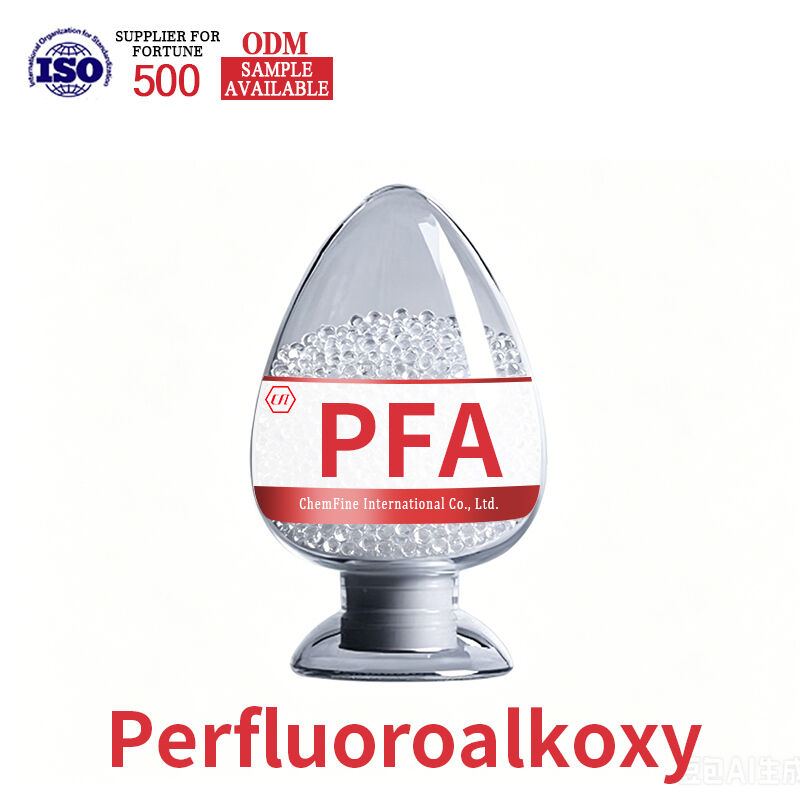
Milky White Translucent Granules
Core Functions:
High Temperature Resistance, Corrosion Resistance, Electrical Insulation, High Purity, Low Friction
Processing Methods:
Compression Molding, Extrusion, Injection Molding, High Speed Thin-wall Extrusion
Shelf Life:
24 Months Under Clean Cool Dry Sealed Storage
Main Applications:
Semiconductor Components, Chemical Anti-corrosion Lining, High Temperature Cable, PFA Tube & Film, Valve & Pump Fittings
Supply Ability:
2,000 Metric Tons per year
Product Description
Product Selling Points
  • PTFE-equivalent performance with thermoplastic processability: Shares nearly the same excellent properties and service temperature as PTFE, with lower crystallinity and melting viscosity. Can be processed by conventional thermoplastic methods including molding, extrusion and injection, greatly improving production efficiency compared with sintered PTFE.
  • Higher mechanical performance than FEP: Delivers better tensile strength and mechanical toughness than FEP resin, with improved stress crack resistance and creep resistance, more suitable for load-bearing anti-corrosion structural parts and high-demand cable insulation.
  • Full grade matrix for all industrial scenarios: 8 standard grades from low MFR (1.1g/10min) molding grade to ultra-high MFR (80.0g/10min) high-speed extrusion grade, precisely matches different processes from thick-wall lining to ultra-thin fine wire production.
  • Outstanding chemical corrosion resistance: Resistant to almost all strong acids, strong bases, organic solvents and oxidizing agents, with no dissolution and no aging under long-term contact with corrosive media, ideal for chemical equipment lining, pipelines and semiconductor chemical delivery systems.
  • Excellent high & low temperature resistance: Maintains stable mechanical and electrical properties from -200℃ to 260℃ continuously, far superior to general engineering plastics, adapts to extreme working conditions of high and low temperature alternation.
  • Superior dielectric & insulation performance: Extremely low dielectric constant and dielectric loss, stable insulation performance under high temperature and high frequency, ideal insulating material for high-temperature wire, high-frequency cable and electronic components.
  • High purity grade for semiconductor industry: Low ion precipitation, low extractable impurities, meets the strict cleanliness requirements of semiconductor manufacturing. Widely used for wafer carriers, buffer tanks, chemical pipelines and other high-purity components.
  • Excellent weathering & anti-aging property: Outstanding weather resistance, UV resistance and atmospheric aging resistance, no obvious performance degradation after long-term outdoor exposure, service life up to decades.
  • Non-stick & low friction surface: Extremely low surface energy, excellent non-stick and self-lubricating properties, suitable for manufacturing release films, conveyor belts and friction reduction components.
  • Stable quality & large-scale supply: Mature polymerization process with strict quality control on MFR, mechanical properties and impurity content, supports long-term stable supply for semiconductor, chemical and cable industry customers.

Full Grade Specification Table
Grade MFR (g/10min) Tensile Strength (MPa) Elongation at Break (%) Processing Method Main Applications
PW-200 1.1-3.0 30.0 280 Molding, Extrusion Tubing, pump, valve, sheet
PW-300 3.1-8.0 30.0 300 Injection, Extrusion Tubing, film, rod, cable jacket
PW-400 8.1-12.0 28.0 300 Injection, Extrusion Injection molded products, cable jacket
PW-500 12.1-18.0 26.0 320 Injection, Extrusion Injection molded products, cable insulation
PW-601 18.1-27.0 24.0 330 Injection, Extrusion Injection molded products, cable insulation
PW-602 27.1-36.0 24.0 330 Injection, Extrusion Injection molded products, cable insulation
PW-700 36.1-50.0 22.0 300 High speed Extrusion Ultra-thin wall wire & cable, ultra-high flow
PW-800 50.1-80.0 20.0 300 High speed Extrusion Ultra-thin wall wire & cable, ultra-high flow

Product Introduction

Perfluoroalkoxy resin (PFA, CAS 26655-00-5) is a fully fluorinated copolymer of tetrafluoroethylene and perfluoropropyl perfluorovinyl ether, also widely recognized as melt-processable PTFE.

Its performance and long-term service temperature are similar to PTFE, with lower crystallinity and lower melting viscosity. Compared with FEP, PFA has higher mechanical strength, better stress crack resistance and wider temperature adaptability. It can be processed by conventional thermoplastic molding methods such as molding, extrusion and injection molding, which greatly improves processing efficiency. The product provides a complete PW grade matrix from low MFR molding grade to ultra-high MFR high-speed extrusion grade. It is widely used in semiconductor high-purity components, chemical equipment anti-corrosion lining, high-temperature wire and cable insulation, PFA tubing and film, valve pump fittings and other fields. It is one of the most core high-performance fluoroplastics in high-end industrial fields.


Synonyms
  • Perfluoroalkoxy Alkane Resin
  • PFA Fluoroplastic Resin
  • Tetrafluoroethylene Perfluoropropyl Vinyl Ether Copolymer
  • CAS 26655-00-5
  • Melt-processable PTFE
  • Perfluoroalkoxy Copolymer
  • High Purity Semiconductor Fluororesin
  • Poly(tetrafluoroethylene-co-perfluoropropyl vinyl ether)

Core Application Scenarios (Ranked by Importance)
  1. Semiconductor High-purity Components (Fastest Growing High-end Application): The most representative high-end application field. High-purity PFA is used to manufacture wafer carriers, buffer tanks, chemical delivery pipelines, joints and other components. Its ultra-low ion precipitation and excellent corrosion resistance to various high-purity chemical reagents fully meet the strict cleanliness requirements of semiconductor wafer manufacturing, and is an indispensable core material for wet process and chemical delivery systems.

  2. Chemical Anti-corrosion Lining & Valves (Core Industrial Application): The most widely used industrial scenario. Low MFR molding grade PFA is lined on the inner wall of valves, pumps, pipelines and reaction vessels as anti-corrosion layer. It resists almost all strong acids, strong bases and organic solvents, solves severe corrosion problems of chemical equipment, greatly extends equipment service life and reduces maintenance cost, and is widely used in chemical industry, petrochemical and pharmaceutical fields.

  3. High Temperature Wire & Cable Insulation: Extrusion grade PFA is used as insulation layer for high temperature resistant wire, high frequency cable, aerospace wire and ultra-fine electronic wire. Its excellent electrical insulation, 260℃ long-term heat resistance and flame retardancy ensure safe and stable signal transmission under extreme high temperature and harsh environment. Ultra-high flow grades are specially designed for high-speed extrusion of ultra-thin wall fine wires.

  4. PFA Tubing & Fluid Transportation: Extruded into various specifications of PFA tubing, used for high-purity chemical transportation in semiconductor industry, corrosive fluid transportation in chemical industry, and food and medical fluid transportation. It has the advantages of smooth inner wall, no precipitation, corrosion resistance and high temperature resistance, and is the preferred tubing for high-purity and corrosive fluid delivery.

  5. PFA Film & Release Material: Made into high-transparency PFA film by extrusion or calendering, used as release film for composite material molding, anti-corrosion lining film, solar cell packaging film and high-temperature insulating film. It has high light transmittance, excellent weather resistance and non-stick property, and maintains stable performance under long-term high temperature and outdoor environment.

  6. Injection Molded Fittings & Semi-finished Products: Injection grade PFA is used to produce various anti-corrosion fittings, connectors, sealing parts and semi-finished products. It can be processed into complex structural parts at one time, with high dimensional accuracy and excellent comprehensive performance, suitable for customized anti-corrosion components and equipment accessories.

  7. Heat Exchangers & Special Equipment: Used to manufacture PFA heat exchangers and special process equipment, giving full play to its excellent corrosion resistance and thermal conductivity stability, suitable for heat exchange scenarios under corrosive working conditions such as chemical industry and electroplating.

    PFA application

Technical FAQ
Q1: What are the differences among PFA, PTFE and FEP?

A1: PTFE has the best overall performance but cannot be melt-processed, and can only be formed by cold pressing and sintering with low production efficiency. FEP is melt-processable but has lower service temperature and mechanical strength. PFA combines the advantages of both: it has PTFE-equivalent performance and 260℃ long-term service temperature, and can be processed by conventional thermoplastic methods like extrusion and injection molding. It also has higher mechanical strength and better stress crack resistance than FEP, making it the preferred high-end melt-processable fluoroplastic.

Q2: How to select the appropriate PFA grade for production?

A2: Selection is mainly based on processing method and product requirements. For compression molded valve lining, thick sheets and rods, choose low MFR grades such as PW-200; for conventional extrusion of tubes, films and cable jackets, choose medium MFR grades such as PW-300 and PW-400; for injection molded complex fittings, choose PW-400 to PW-602 grades; for high-speed extrusion of ultra-thin wall fine wires, choose high MFR grades such as PW-700 and PW-800 with ultra-high fluidity.

Q3: What is the long-term service temperature of PFA?

A3: PFA can be used stably for a long time in the range of -200℃ to 260℃, and maintains good mechanical and electrical properties in the whole temperature range. Its long-term service temperature is about 30-40℃ higher than FEP, and it also has better thermal stability and thermal aging resistance, suitable for higher temperature working conditions.

Q4: Is PFA suitable for semiconductor high-purity applications?

A4: Yes. High-purity PFA has extremely low ion precipitation and low extractable impurities, will not pollute high-purity chemicals and wafers, and can withstand cleaning of various strong acid and strong base reagents. It is the standard material for semiconductor wet process equipment, chemical delivery systems and wafer carriers, and is widely used in 12-inch wafer production lines.

Q5: What storage and processing precautions should be followed?

A5: Store in a clean, cool and dry environment, sealed to avoid moisture and dust contamination. During processing, the temperature should be controlled within the recommended processing temperature range, and avoid long-term residence at excessively high temperature to prevent resin degradation. It is recommended to clean the extruder or injection machine before processing to avoid impurity mixing affecting product performance.

Q6: Does PFA have flame retardant property?

A6: Yes. PFA has inherent excellent flame retardant property with extremely high limiting oxygen index, it is non-flammable and self-extinguishing. It is one of the preferred insulating materials for high-temperature fire-resistant wires and cables, and meets the flame retardant requirements of aerospace, electronics and industrial fields.

Good price  online

Products Details

Home > Products >
Miscellaneous Chemical
>
PFA Resin Perfluoroalkoxy CAS 26655-00-5

PFA Resin Perfluoroalkoxy CAS 26655-00-5

Brand Name: Chemfine
Packaging Details: 25kg plastic bag / fiber drum; 1000kg bulk box; customized packaging available upon request
Detail Information
Place of Origin:
China
Brand Name:
Chemfine
Certification:
ISO
Chemical Name:
Perfluoroalkoxy Alkane Resin (PFA)
Common Name:
PFA Resin, Perfluoroalkoxy Copolymer
CAS Number:
26655-00-5
EINECS Number:
500-057-7
Molecular Formula:
(C2F4)n · (C3F6O)m
Product Type:
Melt-processable High Performance Fluoropolymer Resin
Appearance:
Milky White Translucent Granules
Core Functions:
High Temperature Resistance, Corrosion Resistance, Electrical Insulation, High Purity, Low Friction
Processing Methods:
Compression Molding, Extrusion, Injection Molding, High Speed Thin-wall Extrusion
Shelf Life:
24 Months Under Clean Cool Dry Sealed Storage
Main Applications:
Semiconductor Components, Chemical Anti-corrosion Lining, High Temperature Cable, PFA Tube & Film, Valve & Pump Fittings
Packaging Details:
25kg plastic bag / fiber drum; 1000kg bulk box; customized packaging available upon request
Supply Ability:
2,000 Metric Tons per year
Product Description
Product Selling Points
  • PTFE-equivalent performance with thermoplastic processability: Shares nearly the same excellent properties and service temperature as PTFE, with lower crystallinity and melting viscosity. Can be processed by conventional thermoplastic methods including molding, extrusion and injection, greatly improving production efficiency compared with sintered PTFE.
  • Higher mechanical performance than FEP: Delivers better tensile strength and mechanical toughness than FEP resin, with improved stress crack resistance and creep resistance, more suitable for load-bearing anti-corrosion structural parts and high-demand cable insulation.
  • Full grade matrix for all industrial scenarios: 8 standard grades from low MFR (1.1g/10min) molding grade to ultra-high MFR (80.0g/10min) high-speed extrusion grade, precisely matches different processes from thick-wall lining to ultra-thin fine wire production.
  • Outstanding chemical corrosion resistance: Resistant to almost all strong acids, strong bases, organic solvents and oxidizing agents, with no dissolution and no aging under long-term contact with corrosive media, ideal for chemical equipment lining, pipelines and semiconductor chemical delivery systems.
  • Excellent high & low temperature resistance: Maintains stable mechanical and electrical properties from -200℃ to 260℃ continuously, far superior to general engineering plastics, adapts to extreme working conditions of high and low temperature alternation.
  • Superior dielectric & insulation performance: Extremely low dielectric constant and dielectric loss, stable insulation performance under high temperature and high frequency, ideal insulating material for high-temperature wire, high-frequency cable and electronic components.
  • High purity grade for semiconductor industry: Low ion precipitation, low extractable impurities, meets the strict cleanliness requirements of semiconductor manufacturing. Widely used for wafer carriers, buffer tanks, chemical pipelines and other high-purity components.
  • Excellent weathering & anti-aging property: Outstanding weather resistance, UV resistance and atmospheric aging resistance, no obvious performance degradation after long-term outdoor exposure, service life up to decades.
  • Non-stick & low friction surface: Extremely low surface energy, excellent non-stick and self-lubricating properties, suitable for manufacturing release films, conveyor belts and friction reduction components.
  • Stable quality & large-scale supply: Mature polymerization process with strict quality control on MFR, mechanical properties and impurity content, supports long-term stable supply for semiconductor, chemical and cable industry customers.

Full Grade Specification Table
Grade MFR (g/10min) Tensile Strength (MPa) Elongation at Break (%) Processing Method Main Applications
PW-200 1.1-3.0 30.0 280 Molding, Extrusion Tubing, pump, valve, sheet
PW-300 3.1-8.0 30.0 300 Injection, Extrusion Tubing, film, rod, cable jacket
PW-400 8.1-12.0 28.0 300 Injection, Extrusion Injection molded products, cable jacket
PW-500 12.1-18.0 26.0 320 Injection, Extrusion Injection molded products, cable insulation
PW-601 18.1-27.0 24.0 330 Injection, Extrusion Injection molded products, cable insulation
PW-602 27.1-36.0 24.0 330 Injection, Extrusion Injection molded products, cable insulation
PW-700 36.1-50.0 22.0 300 High speed Extrusion Ultra-thin wall wire & cable, ultra-high flow
PW-800 50.1-80.0 20.0 300 High speed Extrusion Ultra-thin wall wire & cable, ultra-high flow

Product Introduction

Perfluoroalkoxy resin (PFA, CAS 26655-00-5) is a fully fluorinated copolymer of tetrafluoroethylene and perfluoropropyl perfluorovinyl ether, also widely recognized as melt-processable PTFE.

Its performance and long-term service temperature are similar to PTFE, with lower crystallinity and lower melting viscosity. Compared with FEP, PFA has higher mechanical strength, better stress crack resistance and wider temperature adaptability. It can be processed by conventional thermoplastic molding methods such as molding, extrusion and injection molding, which greatly improves processing efficiency. The product provides a complete PW grade matrix from low MFR molding grade to ultra-high MFR high-speed extrusion grade. It is widely used in semiconductor high-purity components, chemical equipment anti-corrosion lining, high-temperature wire and cable insulation, PFA tubing and film, valve pump fittings and other fields. It is one of the most core high-performance fluoroplastics in high-end industrial fields.


Synonyms
  • Perfluoroalkoxy Alkane Resin
  • PFA Fluoroplastic Resin
  • Tetrafluoroethylene Perfluoropropyl Vinyl Ether Copolymer
  • CAS 26655-00-5
  • Melt-processable PTFE
  • Perfluoroalkoxy Copolymer
  • High Purity Semiconductor Fluororesin
  • Poly(tetrafluoroethylene-co-perfluoropropyl vinyl ether)

Core Application Scenarios (Ranked by Importance)
  1. Semiconductor High-purity Components (Fastest Growing High-end Application): The most representative high-end application field. High-purity PFA is used to manufacture wafer carriers, buffer tanks, chemical delivery pipelines, joints and other components. Its ultra-low ion precipitation and excellent corrosion resistance to various high-purity chemical reagents fully meet the strict cleanliness requirements of semiconductor wafer manufacturing, and is an indispensable core material for wet process and chemical delivery systems.

  2. Chemical Anti-corrosion Lining & Valves (Core Industrial Application): The most widely used industrial scenario. Low MFR molding grade PFA is lined on the inner wall of valves, pumps, pipelines and reaction vessels as anti-corrosion layer. It resists almost all strong acids, strong bases and organic solvents, solves severe corrosion problems of chemical equipment, greatly extends equipment service life and reduces maintenance cost, and is widely used in chemical industry, petrochemical and pharmaceutical fields.

  3. High Temperature Wire & Cable Insulation: Extrusion grade PFA is used as insulation layer for high temperature resistant wire, high frequency cable, aerospace wire and ultra-fine electronic wire. Its excellent electrical insulation, 260℃ long-term heat resistance and flame retardancy ensure safe and stable signal transmission under extreme high temperature and harsh environment. Ultra-high flow grades are specially designed for high-speed extrusion of ultra-thin wall fine wires.

  4. PFA Tubing & Fluid Transportation: Extruded into various specifications of PFA tubing, used for high-purity chemical transportation in semiconductor industry, corrosive fluid transportation in chemical industry, and food and medical fluid transportation. It has the advantages of smooth inner wall, no precipitation, corrosion resistance and high temperature resistance, and is the preferred tubing for high-purity and corrosive fluid delivery.

  5. PFA Film & Release Material: Made into high-transparency PFA film by extrusion or calendering, used as release film for composite material molding, anti-corrosion lining film, solar cell packaging film and high-temperature insulating film. It has high light transmittance, excellent weather resistance and non-stick property, and maintains stable performance under long-term high temperature and outdoor environment.

  6. Injection Molded Fittings & Semi-finished Products: Injection grade PFA is used to produce various anti-corrosion fittings, connectors, sealing parts and semi-finished products. It can be processed into complex structural parts at one time, with high dimensional accuracy and excellent comprehensive performance, suitable for customized anti-corrosion components and equipment accessories.

  7. Heat Exchangers & Special Equipment: Used to manufacture PFA heat exchangers and special process equipment, giving full play to its excellent corrosion resistance and thermal conductivity stability, suitable for heat exchange scenarios under corrosive working conditions such as chemical industry and electroplating.

    PFA application

Technical FAQ
Q1: What are the differences among PFA, PTFE and FEP?

A1: PTFE has the best overall performance but cannot be melt-processed, and can only be formed by cold pressing and sintering with low production efficiency. FEP is melt-processable but has lower service temperature and mechanical strength. PFA combines the advantages of both: it has PTFE-equivalent performance and 260℃ long-term service temperature, and can be processed by conventional thermoplastic methods like extrusion and injection molding. It also has higher mechanical strength and better stress crack resistance than FEP, making it the preferred high-end melt-processable fluoroplastic.

Q2: How to select the appropriate PFA grade for production?

A2: Selection is mainly based on processing method and product requirements. For compression molded valve lining, thick sheets and rods, choose low MFR grades such as PW-200; for conventional extrusion of tubes, films and cable jackets, choose medium MFR grades such as PW-300 and PW-400; for injection molded complex fittings, choose PW-400 to PW-602 grades; for high-speed extrusion of ultra-thin wall fine wires, choose high MFR grades such as PW-700 and PW-800 with ultra-high fluidity.

Q3: What is the long-term service temperature of PFA?

A3: PFA can be used stably for a long time in the range of -200℃ to 260℃, and maintains good mechanical and electrical properties in the whole temperature range. Its long-term service temperature is about 30-40℃ higher than FEP, and it also has better thermal stability and thermal aging resistance, suitable for higher temperature working conditions.

Q4: Is PFA suitable for semiconductor high-purity applications?

A4: Yes. High-purity PFA has extremely low ion precipitation and low extractable impurities, will not pollute high-purity chemicals and wafers, and can withstand cleaning of various strong acid and strong base reagents. It is the standard material for semiconductor wet process equipment, chemical delivery systems and wafer carriers, and is widely used in 12-inch wafer production lines.

Q5: What storage and processing precautions should be followed?

A5: Store in a clean, cool and dry environment, sealed to avoid moisture and dust contamination. During processing, the temperature should be controlled within the recommended processing temperature range, and avoid long-term residence at excessively high temperature to prevent resin degradation. It is recommended to clean the extruder or injection machine before processing to avoid impurity mixing affecting product performance.

Q6: Does PFA have flame retardant property?

A6: Yes. PFA has inherent excellent flame retardant property with extremely high limiting oxygen index, it is non-flammable and self-extinguishing. It is one of the preferred insulating materials for high-temperature fire-resistant wires and cables, and meets the flame retardant requirements of aerospace, electronics and industrial fields.