logo
Good price  online

products details

Home > Products >
Organic Chemistry Solvents
>
FEP Dispersion CAS 25067-11-2 Fluorinated Ethylene Propylene

FEP Dispersion CAS 25067-11-2 Fluorinated Ethylene Propylene

Brand Name: Chemfine
Packaging Details: 25kg / 50kg plastic drum; 1000L IBC tote; Customized packaging available upon request
Detail Information
Place of Origin:
China
Certification:
ISO
Chemical Name:
Fluorinated Ethylene Propylene Aqueous Dispersion
Common Name:
FEP Dispersion / FEP Emulsion
CAS Number:
25067-11-2
Product Type:
Aqueous Fluoropolymer Coating & Impregnation Emulsion
Appearance:
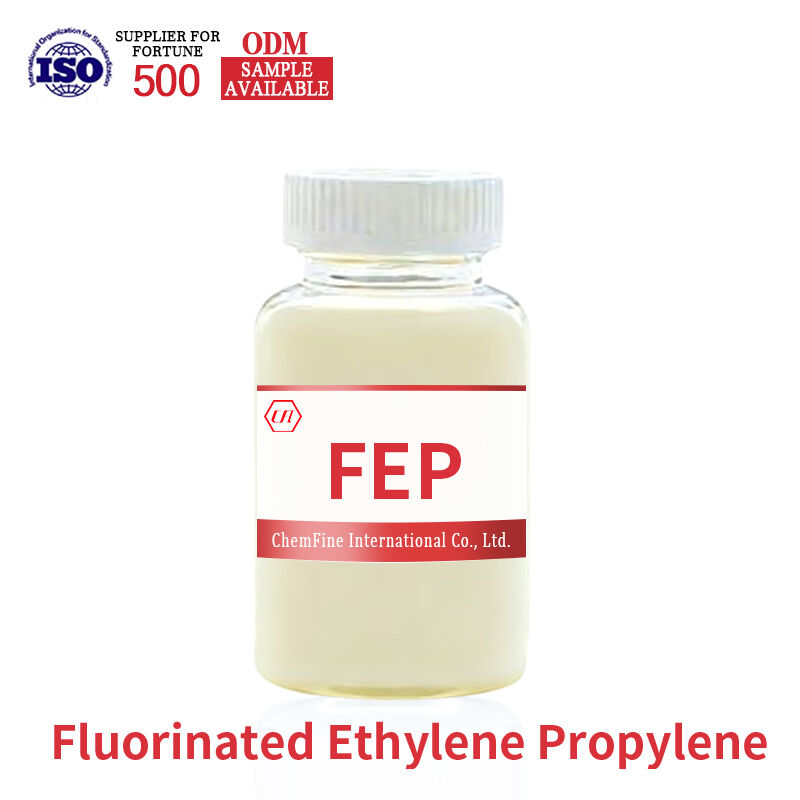
White Or Light Yellow Homogeneous Liquid
Core Functions:
High Temperature Resistance, Anti-corrosion, Non-stick, Insulation, Fiber Impregnation Reinforcement
Recommended Application:
Impregnation Of Glass Fiber, Packing, Thick Layer Anti-corrosion Coating
Shelf Life:
12 Months Under Sealed Cool Storage
Supply Ability:
1,500 Metric Tons per year
Product Description
Product Selling Points
  • Dual MFR grades for flexible process matching: Two standard grades with MFR 2.0-5.0 and 5.1-8.0, adapt to different impregnation, coating and film forming processes, meet diversified production requirements from thick layer impregnation to thin film coating.
  • Stable 50±2% solid content: Uniform and consistent solid content with narrow fluctuation range, ensures stable coating thickness and film performance, avoids batch-to-batch difference in production.
  • Neutral to weak alkaline pH 7.0-9.0: Mild pH property, good compatibility with most substrates and auxiliary additives, no corrosion to production equipment and metal substrates.
  • Specific gravity 1.34-1.40 stable emulsion system: Uniform dispersion with excellent storage stability, not easy to delaminate and precipitate, easy to dilute and construct on site.
  • Inherited premium FEP fluororesin performance: Fully retains the excellent properties of FEP resin including high and low temperature resistance, outstanding chemical corrosion resistance, low surface energy non-stick property and excellent electrical insulation.
  • Excellent non-stick & anti-fouling effect: Cured coating has extremely low surface tension, excellent non-stick and oil-repellent performance, easy to clean, widely used in cookware non-stick coating and industrial anti-fouling lining.
  • Reliable anti-corrosion protection: The cured film resists almost all strong acids, strong bases, organic solvents and oxidizing media, provides long-term anti-corrosion protection for metal fasteners, chemical equipment and pipeline inner walls.
  • Wide substrate adaptability: Suitable for glass fiber, glass cloth, packing, fabric, filter bag, polyimide film and various metal substrates, can be applied by spraying, dipping, roller coating and other processes.
  • High temperature resistant durable coating: Long-term service temperature up to 200℃, good weather resistance and aging resistance, no cracking and peeling after long-term use, long coating service life.
  • Mature production stable supply: Mature emulsion polymerization process, strict quality control of particle size and solid content, supports long-term stable bulk supply for downstream coating and impregnation manufacturers.

Certificate of Analysis (COA)
Product Name: Fluorinated Ethylene Propylene (FEP) Aqueous Dispersion
CAS No.: 25067-11-2
Item Standard Specification
Appearance White or light yellow homogeneous liquid
Specific Gravity (23℃) 1.34 - 1.40 g/cm³
Solid Content 50 ± 2 %
pH Value 7.0 - 9.0
Melt Flow Rate 2.0 - 5.0 g/10min / 5.1 - 8.0 g/10min (by grade)
CONCLUSION Conforms to Standard

Product Introduction

Fluorinated Ethylene Propylene (FEP) aqueous dispersion (CAS 25067-11-2) is a stable milky fluoropolymer emulsion prepared by emulsion polymerization of tetrafluoroethylene and hexafluoropropylene.

It fully retains the excellent comprehensive properties of FEP resin, such as outstanding high and low temperature resistance, excellent chemical corrosion resistance, remarkable non-stick property and superior electrical insulation. With 50±2% stable solid content and two optional MFR grades, it can be applied by spraying, dipping, roller coating and other processes. After curing and film forming at high temperature, it forms a dense, uniform and durable fluorine-containing coating. It is widely used in non-stick coating of cookware, anti-corrosion coating of metal equipment, glass fiber and packing impregnation, fabric and filter bag coating, polyimide film coating and other fields, and is a high-performance functional fluorine-containing coating material.


Synonyms
  • FEP Aqueous Dispersion
  • Fluorinated Ethylene Propylene Emulsion
  • FEP Coating Emulsion
  • CAS 25067-11-2
  • Perfluoroethylene Propylene Aqueous Emulsion
  • Fluoropolymer Coating Dispersion
  • Glass Fiber Impregnation FEP Emulsion
  • Non-stick Cookware FEP Coating

Core Application Scenarios (Ranked by Importance)
  1. Cookware Non-stick Coating (Core Application): The most widely used scenario. Used as base coating or top coating for various non-stick cookware such as frying pans, baking trays and cake molds. The cured coating has excellent non-stick property, high temperature resistance and food contact safety, is easy to clean, and maintains stable performance under long-term high-temperature cooking conditions.

  2. Industrial Metal Anti-corrosion Coating: Applied on the surface of metal fasteners, chemical equipment, pipelines and valves as anti-corrosion protective layer. It resists erosion of strong acid, strong alkali, organic solvent and corrosive gas, greatly extends the service life of metal parts, and is widely used in chemical industry, electric power and marine engineering fields.

  3. Glass Fiber & Packing Impregnation: Used for impregnation of glass fiber cloth, glass fiber yarn and sealing packing. After impregnation and curing, it improves the high temperature resistance, corrosion resistance and wear resistance of fiber and packing products, enhances sealing performance and service life, and is suitable for manufacturing high-performance sealing materials and fiber reinforced products.

  4. Fabric & Filter Bag Coating: Coated on industrial filter bags, high-temperature filter fabrics and special functional fabrics. It endows fabrics with excellent water and oil repellency, chemical corrosion resistance and dust release property, improves filtration efficiency and service life of filter bags, and is widely used in dust removal, chemical filtration and other fields.

  5. Polyimide Film Surface Coating: Used for surface coating of polyimide film and other high-temperature resistant films. It improves the surface smoothness, electrical insulation and weather resistance of the film, and is widely used in electronic insulation films, flexible circuit board substrates and other high-end electronic materials.

  6. Other Functional Coatings: Also used for surface coating of textile products, special paper and electronic components, providing functions such as high temperature resistance, insulation, anti-sticking and anti-fouling, and can be customized according to different substrate and performance requirements.


Technical FAQ
Q1: What is the difference between the two MFR grades of FEP dispersion?

A1: The low MFR grade (2.0-5.0 g/10min) has higher molecular weight and better mechanical strength and toughness of the cured film, which is more suitable for glass fiber impregnation, packing impregnation and thick anti-corrosion coating scenarios requiring high film strength. The high MFR grade (5.1-8.0 g/10min) has better fluidity and leveling property after melting, and is easier to form a smooth and uniform thin film, which is more suitable for polyimide film coating, thin non-stick coating and metallic coating scenarios requiring high surface flatness.

Q2: What construction methods can FEP dispersion adopt?

A2: FEP aqueous dispersion can be applied by spraying, dipping, roller coating, brushing and other processes. The appropriate construction method can be selected according to the shape of the workpiece and the coating requirements. Before construction, it can be diluted with deionized water to adjust viscosity according to process requirements, and it needs to be stirred evenly before use.

Q3: What is the curing process of FEP dispersion coating?

A3: After coating, it usually needs to be dried at low temperature first to remove moisture, and then sintered at high temperature of 350-380℃ to form a film. The specific drying and sintering temperature and time should be adjusted according to coating thickness, substrate type and production process. Sufficient sintering temperature and time shall be ensured to obtain a dense and well-bonded fluorine coating.

Q4: What storage precautions should be paid attention to?

A4: FEP dispersion should be stored in a tightly sealed original container at 5-35℃. Freezing and long-term exposure to high temperature environment should be avoided, otherwise the emulsion will break and delaminate. It should be stirred evenly before use after long-term storage. Do not mix with other incompatible chemicals. The shelf life is 12 months under proper storage conditions.

Q5: Is FEP dispersion coating food contact safe?

A5: Food contact grade FEP dispersion complies with relevant food contact material standards, and can be safely used for non-stick coating of food processing equipment and cookware after proper sintering curing. Ordinary industrial grades are mainly used for industrial anti-corrosion and other scenarios. Please confirm the product grade before using in food contact scenarios.

Q6: What substrates is FEP dispersion suitable for?

A6: It has good adhesion to various metal substrates such as iron, aluminum and stainless steel after proper surface pretreatment. It is also suitable for impregnation and coating of glass fiber, carbon fiber, aramid fabric, polyimide film and other high temperature resistant substrates. For special substrates, adhesion test is recommended before mass production.

Good price  online

Products Details

Home > Products >
Organic Chemistry Solvents
>
FEP Dispersion CAS 25067-11-2 Fluorinated Ethylene Propylene

FEP Dispersion CAS 25067-11-2 Fluorinated Ethylene Propylene

Brand Name: Chemfine
Packaging Details: 25kg / 50kg plastic drum; 1000L IBC tote; Customized packaging available upon request
Detail Information
Place of Origin:
China
Brand Name:
Chemfine
Certification:
ISO
Chemical Name:
Fluorinated Ethylene Propylene Aqueous Dispersion
Common Name:
FEP Dispersion / FEP Emulsion
CAS Number:
25067-11-2
Product Type:
Aqueous Fluoropolymer Coating & Impregnation Emulsion
Appearance:
White Or Light Yellow Homogeneous Liquid
Core Functions:
High Temperature Resistance, Anti-corrosion, Non-stick, Insulation, Fiber Impregnation Reinforcement
Recommended Application:
Impregnation Of Glass Fiber, Packing, Thick Layer Anti-corrosion Coating
Shelf Life:
12 Months Under Sealed Cool Storage
Packaging Details:
25kg / 50kg plastic drum; 1000L IBC tote; Customized packaging available upon request
Supply Ability:
1,500 Metric Tons per year
Product Description
Product Selling Points
  • Dual MFR grades for flexible process matching: Two standard grades with MFR 2.0-5.0 and 5.1-8.0, adapt to different impregnation, coating and film forming processes, meet diversified production requirements from thick layer impregnation to thin film coating.
  • Stable 50±2% solid content: Uniform and consistent solid content with narrow fluctuation range, ensures stable coating thickness and film performance, avoids batch-to-batch difference in production.
  • Neutral to weak alkaline pH 7.0-9.0: Mild pH property, good compatibility with most substrates and auxiliary additives, no corrosion to production equipment and metal substrates.
  • Specific gravity 1.34-1.40 stable emulsion system: Uniform dispersion with excellent storage stability, not easy to delaminate and precipitate, easy to dilute and construct on site.
  • Inherited premium FEP fluororesin performance: Fully retains the excellent properties of FEP resin including high and low temperature resistance, outstanding chemical corrosion resistance, low surface energy non-stick property and excellent electrical insulation.
  • Excellent non-stick & anti-fouling effect: Cured coating has extremely low surface tension, excellent non-stick and oil-repellent performance, easy to clean, widely used in cookware non-stick coating and industrial anti-fouling lining.
  • Reliable anti-corrosion protection: The cured film resists almost all strong acids, strong bases, organic solvents and oxidizing media, provides long-term anti-corrosion protection for metal fasteners, chemical equipment and pipeline inner walls.
  • Wide substrate adaptability: Suitable for glass fiber, glass cloth, packing, fabric, filter bag, polyimide film and various metal substrates, can be applied by spraying, dipping, roller coating and other processes.
  • High temperature resistant durable coating: Long-term service temperature up to 200℃, good weather resistance and aging resistance, no cracking and peeling after long-term use, long coating service life.
  • Mature production stable supply: Mature emulsion polymerization process, strict quality control of particle size and solid content, supports long-term stable bulk supply for downstream coating and impregnation manufacturers.

Certificate of Analysis (COA)
Product Name: Fluorinated Ethylene Propylene (FEP) Aqueous Dispersion
CAS No.: 25067-11-2
Item Standard Specification
Appearance White or light yellow homogeneous liquid
Specific Gravity (23℃) 1.34 - 1.40 g/cm³
Solid Content 50 ± 2 %
pH Value 7.0 - 9.0
Melt Flow Rate 2.0 - 5.0 g/10min / 5.1 - 8.0 g/10min (by grade)
CONCLUSION Conforms to Standard

Product Introduction

Fluorinated Ethylene Propylene (FEP) aqueous dispersion (CAS 25067-11-2) is a stable milky fluoropolymer emulsion prepared by emulsion polymerization of tetrafluoroethylene and hexafluoropropylene.

It fully retains the excellent comprehensive properties of FEP resin, such as outstanding high and low temperature resistance, excellent chemical corrosion resistance, remarkable non-stick property and superior electrical insulation. With 50±2% stable solid content and two optional MFR grades, it can be applied by spraying, dipping, roller coating and other processes. After curing and film forming at high temperature, it forms a dense, uniform and durable fluorine-containing coating. It is widely used in non-stick coating of cookware, anti-corrosion coating of metal equipment, glass fiber and packing impregnation, fabric and filter bag coating, polyimide film coating and other fields, and is a high-performance functional fluorine-containing coating material.


Synonyms
  • FEP Aqueous Dispersion
  • Fluorinated Ethylene Propylene Emulsion
  • FEP Coating Emulsion
  • CAS 25067-11-2
  • Perfluoroethylene Propylene Aqueous Emulsion
  • Fluoropolymer Coating Dispersion
  • Glass Fiber Impregnation FEP Emulsion
  • Non-stick Cookware FEP Coating

Core Application Scenarios (Ranked by Importance)
  1. Cookware Non-stick Coating (Core Application): The most widely used scenario. Used as base coating or top coating for various non-stick cookware such as frying pans, baking trays and cake molds. The cured coating has excellent non-stick property, high temperature resistance and food contact safety, is easy to clean, and maintains stable performance under long-term high-temperature cooking conditions.

  2. Industrial Metal Anti-corrosion Coating: Applied on the surface of metal fasteners, chemical equipment, pipelines and valves as anti-corrosion protective layer. It resists erosion of strong acid, strong alkali, organic solvent and corrosive gas, greatly extends the service life of metal parts, and is widely used in chemical industry, electric power and marine engineering fields.

  3. Glass Fiber & Packing Impregnation: Used for impregnation of glass fiber cloth, glass fiber yarn and sealing packing. After impregnation and curing, it improves the high temperature resistance, corrosion resistance and wear resistance of fiber and packing products, enhances sealing performance and service life, and is suitable for manufacturing high-performance sealing materials and fiber reinforced products.

  4. Fabric & Filter Bag Coating: Coated on industrial filter bags, high-temperature filter fabrics and special functional fabrics. It endows fabrics with excellent water and oil repellency, chemical corrosion resistance and dust release property, improves filtration efficiency and service life of filter bags, and is widely used in dust removal, chemical filtration and other fields.

  5. Polyimide Film Surface Coating: Used for surface coating of polyimide film and other high-temperature resistant films. It improves the surface smoothness, electrical insulation and weather resistance of the film, and is widely used in electronic insulation films, flexible circuit board substrates and other high-end electronic materials.

  6. Other Functional Coatings: Also used for surface coating of textile products, special paper and electronic components, providing functions such as high temperature resistance, insulation, anti-sticking and anti-fouling, and can be customized according to different substrate and performance requirements.


Technical FAQ
Q1: What is the difference between the two MFR grades of FEP dispersion?

A1: The low MFR grade (2.0-5.0 g/10min) has higher molecular weight and better mechanical strength and toughness of the cured film, which is more suitable for glass fiber impregnation, packing impregnation and thick anti-corrosion coating scenarios requiring high film strength. The high MFR grade (5.1-8.0 g/10min) has better fluidity and leveling property after melting, and is easier to form a smooth and uniform thin film, which is more suitable for polyimide film coating, thin non-stick coating and metallic coating scenarios requiring high surface flatness.

Q2: What construction methods can FEP dispersion adopt?

A2: FEP aqueous dispersion can be applied by spraying, dipping, roller coating, brushing and other processes. The appropriate construction method can be selected according to the shape of the workpiece and the coating requirements. Before construction, it can be diluted with deionized water to adjust viscosity according to process requirements, and it needs to be stirred evenly before use.

Q3: What is the curing process of FEP dispersion coating?

A3: After coating, it usually needs to be dried at low temperature first to remove moisture, and then sintered at high temperature of 350-380℃ to form a film. The specific drying and sintering temperature and time should be adjusted according to coating thickness, substrate type and production process. Sufficient sintering temperature and time shall be ensured to obtain a dense and well-bonded fluorine coating.

Q4: What storage precautions should be paid attention to?

A4: FEP dispersion should be stored in a tightly sealed original container at 5-35℃. Freezing and long-term exposure to high temperature environment should be avoided, otherwise the emulsion will break and delaminate. It should be stirred evenly before use after long-term storage. Do not mix with other incompatible chemicals. The shelf life is 12 months under proper storage conditions.

Q5: Is FEP dispersion coating food contact safe?

A5: Food contact grade FEP dispersion complies with relevant food contact material standards, and can be safely used for non-stick coating of food processing equipment and cookware after proper sintering curing. Ordinary industrial grades are mainly used for industrial anti-corrosion and other scenarios. Please confirm the product grade before using in food contact scenarios.

Q6: What substrates is FEP dispersion suitable for?

A6: It has good adhesion to various metal substrates such as iron, aluminum and stainless steel after proper surface pretreatment. It is also suitable for impregnation and coating of glass fiber, carbon fiber, aramid fabric, polyimide film and other high temperature resistant substrates. For special substrates, adhesion test is recommended before mass production.