|
|
| Brand Name: | Chemfine |
| Packaging Details: | 25kg kraft paper bag with inner food-grade PE liner; customized packaging available upon request |
| Item | Standard Specification |
|---|---|
| Appearance | Yellowish to white flowing powder |
| Particle Size | 90% pass 60 mesh |
| Sulphate (count by SO42-, %) | 15 - 40 |
| Loss on Drying (%) | ≤ 12 |
| Total Ash Content (%) | 15 - 40 |
| Viscosity (mPa.s) | ≥ 5.0 |
| Gel Strength (KCl, g/cm²) | ≥ 1,400 |
| Transparency (T%) | ≥ 70 |
| Acid-insoluble ash (%) | ≤ 1.0 |
| pH level | 8.0 - 11.0 |
| Arsenic (mg/kg) | ≤ 3.0 |
| Lead (mg/kg) | ≤ 5.0 |
| Mercury (mg/kg) | ≤ 1.0 |
| Cadmium (mg/kg) | ≤ 2.0 |
| Total Plate Count (CFU/g) | ≤ 5,000 |
| Yeast & Moulds (CFU/g) | ≤ 300 |
| E. coli | Absent in 5g |
| Salmonella | Absent in 10g |
| CONCLUSION | Conforms to Standard |
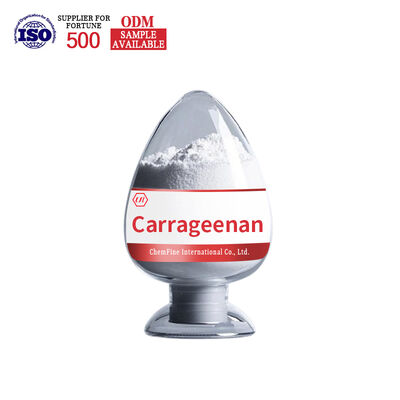
Carrageenan (CAS 9000-07-1) is a natural sulfated polysaccharide colloid extracted from red seaweed, appearing as yellowish to white flowing powder.
As a classic natural food hydrocolloid, it has excellent gelling, thickening, emulsifying and stabilizing properties, and can form thermoreversible elastic gel in aqueous solution. It is widely used in dairy products, meat processing, beverages, jellies, candies and baked goods to improve product texture, enhance water retention and maintain system stability. This product is refined by advanced extraction and purification process, with strictly controlled heavy metals and microbial indicators, fully meeting food safety requirements. In addition to food industry, it is also used in daily chemical, pharmaceutical and other fields as thickener and excipient. It is a multifunctional natural gum with wide industrial applications.
Food Gelling & Dessert Products (Core Application): The most classic application. Used as gelling agent in jelly, pudding, soft candy, jam and other products. It forms transparent, elastic and smooth gel with good thermal reversibility, gives products delicate taste and stable texture, and is the core raw material for most gel desserts.
Dairy & Beverage Industry: Used as stabilizer and thickener in milk drinks, yogurt, plant protein drinks and ice cream. It prevents protein precipitation and fat stratification, improves product smoothness and taste, enhances creaminess of dairy products, and maintains stable quality during shelf life.
Meat & Aquatic Product Processing: Used in ham, sausage, canned meat, surimi products and restructured meat as binder and water retaining agent. It improves product sliceability, elasticity and water holding capacity, reduces cooking loss, enhances product yield and taste, and is an important quality improver for meat products.
Bakery & Confectionery: Used in bread, cakes, fillings and candies to improve dough water retention, delay starch retrogradation, extend product shelf life, and endow candy with good elasticity and non-stick performance.
Personal Care & Daily Chemicals: Used as thickener, emulsifier and suspending agent in shampoo, body wash, facial cleanser, toothpaste and skin care products. It improves product viscosity and system stability, gives skin care products smooth skin feel, and has good compatibility with other cosmetic raw materials.
Pharmaceutical & Other Industrial Uses: Used as excipient and sustained-release carrier in pharmaceutical industry for capsule, suspension and sustained-release preparation; also used in textile printing and dyeing, building materials and other industries as thickener and sizing agent.
A1: Carrageenan is a negatively charged sulfated polysaccharide. In aqueous solution, when heated, its molecular chains disperse and dissolve; when cooled, the molecular chains form a double helix structure and further assemble into a three-dimensional gel network, locking water molecules to form elastic gel. Cations such as potassium ions can significantly promote gel formation and improve gel strength. Different types of carrageenan form gels with different hardness and elasticity.
A2: The addition amount varies with application scenarios. For jelly and pudding, it is usually 0.3-1.0%; for dairy beverages and yogurt, it is 0.05-0.3%; for meat products, it is 0.2-0.8%; for ice cream, it is 0.1-0.4%. The optimal dosage should be determined according to specific formula, product texture requirements and raw material compatibility test.
A3: Carrageenan is easy to agglomerate when directly added to water. It is recommended to first mix it evenly with sugar, salt or other dry powder raw materials to disperse the powder, then add it to warm water at 60-80℃ under stirring, and heat it to above 80℃ with continuous stirring until it is completely dissolved. After complete dissolution, cooling will form a uniform gel. Sufficient heating and stirring are the key to ensure full dissolution and avoid agglomeration.
A4: Carrageenan powder is easy to absorb moisture, so it must be stored in tightly sealed original packaging in a cool, dry and well-ventilated warehouse. Avoid humid environment and direct sunlight, and do not store together with substances with strong odor to prevent odor absorption. The product is easy to agglomerate after moisture absorption, which will affect dissolution and use effect. The shelf life is 24 months under proper sealed storage.
A5: Yes. Carrageenan is extracted from natural red seaweed, belonging to plant-derived raw materials, free of animal ingredients, suitable for vegan, vegetarian and halal food production. It is a widely recognized plant-based gelling and thickening agent in the global plant-based food industry, which can replace animal-derived gelatin in most gel scenarios.
A6: Carrageenan has good synergistic effect with konjac gum, locust bean gum and xanthan gum. For example, compounding with konjac gum can significantly improve gel elasticity and water retention, reduce brittleness of pure carrageenan gel; compounding with locust bean gum can adjust gel hardness and elasticity. Through compounding with other colloids, the texture and performance of the product can be flexibly adjusted to meet different product requirements.
|
| Brand Name: | Chemfine |
| Packaging Details: | 25kg kraft paper bag with inner food-grade PE liner; customized packaging available upon request |
| Item | Standard Specification |
|---|---|
| Appearance | Yellowish to white flowing powder |
| Particle Size | 90% pass 60 mesh |
| Sulphate (count by SO42-, %) | 15 - 40 |
| Loss on Drying (%) | ≤ 12 |
| Total Ash Content (%) | 15 - 40 |
| Viscosity (mPa.s) | ≥ 5.0 |
| Gel Strength (KCl, g/cm²) | ≥ 1,400 |
| Transparency (T%) | ≥ 70 |
| Acid-insoluble ash (%) | ≤ 1.0 |
| pH level | 8.0 - 11.0 |
| Arsenic (mg/kg) | ≤ 3.0 |
| Lead (mg/kg) | ≤ 5.0 |
| Mercury (mg/kg) | ≤ 1.0 |
| Cadmium (mg/kg) | ≤ 2.0 |
| Total Plate Count (CFU/g) | ≤ 5,000 |
| Yeast & Moulds (CFU/g) | ≤ 300 |
| E. coli | Absent in 5g |
| Salmonella | Absent in 10g |
| CONCLUSION | Conforms to Standard |
Carrageenan (CAS 9000-07-1) is a natural sulfated polysaccharide colloid extracted from red seaweed, appearing as yellowish to white flowing powder.
As a classic natural food hydrocolloid, it has excellent gelling, thickening, emulsifying and stabilizing properties, and can form thermoreversible elastic gel in aqueous solution. It is widely used in dairy products, meat processing, beverages, jellies, candies and baked goods to improve product texture, enhance water retention and maintain system stability. This product is refined by advanced extraction and purification process, with strictly controlled heavy metals and microbial indicators, fully meeting food safety requirements. In addition to food industry, it is also used in daily chemical, pharmaceutical and other fields as thickener and excipient. It is a multifunctional natural gum with wide industrial applications.
Food Gelling & Dessert Products (Core Application): The most classic application. Used as gelling agent in jelly, pudding, soft candy, jam and other products. It forms transparent, elastic and smooth gel with good thermal reversibility, gives products delicate taste and stable texture, and is the core raw material for most gel desserts.
Dairy & Beverage Industry: Used as stabilizer and thickener in milk drinks, yogurt, plant protein drinks and ice cream. It prevents protein precipitation and fat stratification, improves product smoothness and taste, enhances creaminess of dairy products, and maintains stable quality during shelf life.
Meat & Aquatic Product Processing: Used in ham, sausage, canned meat, surimi products and restructured meat as binder and water retaining agent. It improves product sliceability, elasticity and water holding capacity, reduces cooking loss, enhances product yield and taste, and is an important quality improver for meat products.
Bakery & Confectionery: Used in bread, cakes, fillings and candies to improve dough water retention, delay starch retrogradation, extend product shelf life, and endow candy with good elasticity and non-stick performance.
Personal Care & Daily Chemicals: Used as thickener, emulsifier and suspending agent in shampoo, body wash, facial cleanser, toothpaste and skin care products. It improves product viscosity and system stability, gives skin care products smooth skin feel, and has good compatibility with other cosmetic raw materials.
Pharmaceutical & Other Industrial Uses: Used as excipient and sustained-release carrier in pharmaceutical industry for capsule, suspension and sustained-release preparation; also used in textile printing and dyeing, building materials and other industries as thickener and sizing agent.
A1: Carrageenan is a negatively charged sulfated polysaccharide. In aqueous solution, when heated, its molecular chains disperse and dissolve; when cooled, the molecular chains form a double helix structure and further assemble into a three-dimensional gel network, locking water molecules to form elastic gel. Cations such as potassium ions can significantly promote gel formation and improve gel strength. Different types of carrageenan form gels with different hardness and elasticity.
A2: The addition amount varies with application scenarios. For jelly and pudding, it is usually 0.3-1.0%; for dairy beverages and yogurt, it is 0.05-0.3%; for meat products, it is 0.2-0.8%; for ice cream, it is 0.1-0.4%. The optimal dosage should be determined according to specific formula, product texture requirements and raw material compatibility test.
A3: Carrageenan is easy to agglomerate when directly added to water. It is recommended to first mix it evenly with sugar, salt or other dry powder raw materials to disperse the powder, then add it to warm water at 60-80℃ under stirring, and heat it to above 80℃ with continuous stirring until it is completely dissolved. After complete dissolution, cooling will form a uniform gel. Sufficient heating and stirring are the key to ensure full dissolution and avoid agglomeration.
A4: Carrageenan powder is easy to absorb moisture, so it must be stored in tightly sealed original packaging in a cool, dry and well-ventilated warehouse. Avoid humid environment and direct sunlight, and do not store together with substances with strong odor to prevent odor absorption. The product is easy to agglomerate after moisture absorption, which will affect dissolution and use effect. The shelf life is 24 months under proper sealed storage.
A5: Yes. Carrageenan is extracted from natural red seaweed, belonging to plant-derived raw materials, free of animal ingredients, suitable for vegan, vegetarian and halal food production. It is a widely recognized plant-based gelling and thickening agent in the global plant-based food industry, which can replace animal-derived gelatin in most gel scenarios.
A6: Carrageenan has good synergistic effect with konjac gum, locust bean gum and xanthan gum. For example, compounding with konjac gum can significantly improve gel elasticity and water retention, reduce brittleness of pure carrageenan gel; compounding with locust bean gum can adjust gel hardness and elasticity. Through compounding with other colloids, the texture and performance of the product can be flexibly adjusted to meet different product requirements.